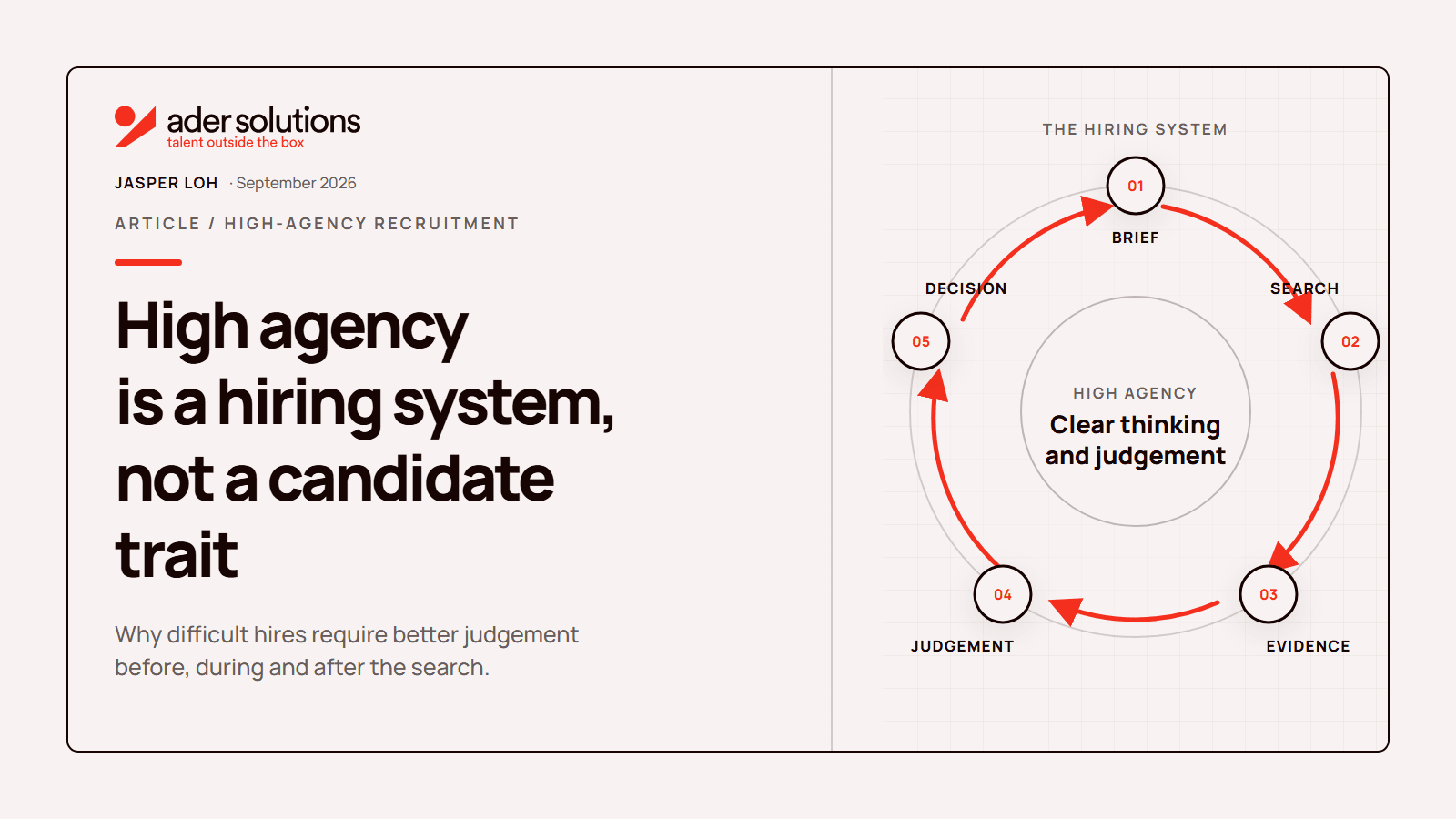
// Why difficult hires require better judgement before, during and after the search.
A strong CV proves what someone has done. It rarely shows what they do when the accepted route fails, the information is incomplete or nobody has a clear answer. That is the hiring signal I have been exploring through this series: high agency.
The phrase is often treated as a candidate characteristic. Someone is described as proactive, resourceful or a self-starter. Those labels sound positive, but they also leave too much open to interpretation.
A candidate can move quickly and still solve the wrong problem. They can challenge an assumption and create unnecessary friction. They can sound decisive in an interview without showing the judgement behind the decision.
High agency requires clear thinking, action and judgement under uncertainty. It also requires a hiring system capable of recognising it.
That second point matters. A company cannot ask for high-agency people while running a low-agency hiring process.
If the brief is vague, the stakeholders are misaligned and the interview rewards confidence over evidence, the process will struggle to identify the behaviour it claims to value.
The search has to start earlier.
// Start with the business problem
Slow searches often begin before the recruiter enters the conversation.
One stakeholder wants a proven operator. Another wants a business builder. A third wants someone who can start immediately, but nobody has agreed which requirement can give.
The recruiter is then asked to solve an argument that the hiring team has not resolved. This is where broad phrases creep into the brief:
- “Strategic but hands-on.”
- “Commercially minded.”
- “Proactive.”
- “Comfortable with ambiguity.”
These descriptions are not useless, but they are incomplete. Each person in the process can interpret them differently.
A stronger mandate answers four questions:
- What must be different 12 months after this person joins?- Name the business change, not the list of responsibilities.
- Which problem remains unsolved today? A market-entry challenge, weak technical capability, delayed delivery and a succession gap require different people.
- What evidence would prove that someone has solved this type of problem before? Titles and employer brands are weak substitutes for proof.
- Which trade-off is the hiring team prepared to make?- Deep sector knowledge, regional experience, technical skills and a build-from-scratch record may not exist in one person at the available level, location and budget.
That final question is often delayed because it is uncomfortable.
Delaying it does not remove the trade-off. It pushes the decision into the shortlist, where it becomes slower and more expensive.
// Search for capability, not familiarity
“No suitable candidates in the market” is usually not a market conclusion.
It is a search conclusion.
Some mandates are extremely difficult and the capability may be scarce. The compensation may be wrong. The location may narrow the available pool.
But a search can also become artificially narrow when it stays attached to one title, one competitor list, one sector background or one version of the person who held the role before.
That is an assumption list, not a complete search strategy.
The better starting point is the problem the hire must solve. From there, test the routes into the required capability:
- Adjacent environments: Where has someone solved the same operational, technical or commercial problem in a different setting?
- Transferable experience: Which parts of the background are genuinely non-negotiable, and which are simply familiar?
- Geography: Is the capability unavailable, or is the search limited to where the company has looked before?
- Succession talent: Who is operating one level below the target title while already carrying the relevant responsibility?
Widening a search does not mean lowering the standard.
It means separating the evidence the role needs from the past hiring patterns the company already knows.
// Assess what happens when the playbook stops working
Most interviews are good at confirming experience.
They are less reliable at showing what someone does when situation changes, the first attempt fails or the accepted answer no longer fits the situation.
Confidence can distort the assessment.
A polished answer may show that a candidate can tell a strong story. It does not establish whether they defined the right problem, tested an assumption or adjusted their approach when the evidence changed.
A more useful question is:
“When you realised the accepted approach was not working, what did you do next?”
Then probe the sequence:
- What did they notice first?
- How did they separate the symptom from the underlying problem?
- Which assumption did they test?
- What action did they take before they had perfect information?
- What failed?
- What did they change?
- Who did they need to bring with them?
The detail matters.
Specific answers show the constraint, decision and consequence. Vague answers hide behind the result. The strongest candidate may not give the smoothest response. The process has to distinguish interview polish from demonstrated judgement.
// Look beyond the conventional CV signals
A CV should open the conversation. It should not end the assessment.
Titles, employer brands and tenure show where someone has been. They do not always show how that person learns, verifies information or builds something that did not exist before.
Five signals are worth probing:
- Self-directed learning: What did the person learn because the work demanded it, not because a course was assigned?
- Verification: When given an accepted answer, did they test it or repeat it?
- Intelligent reinvention: Have they made a considered change when their existing route stopped making sense?
- Evidence of building: Have they created a process, tool, relationship or capability that did not exist before?
- Better questions: Can they explain when they realised the team was solving the wrong problem?
None of these should become a shortcut for instinct or “culture fit”.
A candidate does not need an unusual background, a side project or a dramatic career move to demonstrate high agency.
The evidence may sit inside ordinary work, sometimes the interviewer needs to go digging for it.
Give candidates enough clarity to exercise judgement
High agency is not only relevant to how companies assess candidates.
Senior professionals also need to make considered decisions when there is no obvious push factor.
A familiar manager, stable team and established reputation can make staying feel safer. That does not automatically mean the current role is still the right one.
A sound career decision separates:
Stability from progression; familiarity from fit; an attractive job description from the reality of the role; actual downside from assumed downside.
The hiring process has a responsibility here.
If a company wants a candidate to make a high-quality decision, it must provide enough clarity about the manager, mandate, decision rights, constraints and definition of success.
Pressure is not a substitute for information.
//The process is part of the assessment
A company cannot ask candidates to show high agency while its own hiring process avoids difficult decisions.
Candidates notice when stakeholders describe different versions of the role, interviews drift from the agreed criteria or feedback stalls because nobody owns the decision.
Those are not administrative details. They reveal how the organisation defines problems, handles uncertainty and acts when alignment is incomplete.
The hiring process therefore sends a signal in both directions.
The company is assessing how the candidate thinks and acts. The candidate is assessing whether the company provides enough clarity, trust and decision ownership for that behaviour to succeed.
High agency is valuable in a candidate. It becomes a hiring advantage when the organisation is ready to support it.